
You've waved back at someone who wasn't waving at you. You've told a waiter "you too" after "enjoy your meal." You've pulled a door that clearly says push. These moments feel uniquely embarrassing — but science says they reveal something fascinating about how every human brain works. Here are 23 times people completely misread the situation.
We've All Done This Exact Thing
You see someone waving across the parking lot. Your hand goes up. Your smile widens. And then you realize — they're waving at the person directly behind you. What follows is the most painfully human moment in existence: the slow hand drop, the smooth transition into scratching your head or fixing your hair, the sudden fascination with something on your phone.
Here's the thing — virtually every person alive has done this exact move. It's practically a universal human ritual. And that little moment of awkwardness? It's just the beginning of how spectacularly we all misread the world around us.
The Premature "You Too" Response
"Enjoy your meal!" the waiter says. "You too!" you fire back instantly — and then spend the next forty-five minutes replaying it in your head. You know the waiter isn't eating. They know you know. Yet your brain launched that response like a reflex hammer hit your politeness nerve. Neuroscientists actually have a name for this: scripted response behavior. Your brain stores common social exchanges as pre-packaged scripts to save processing power.
The problem? Sometimes the script fires before your conscious mind catches up. It's a tiny glitch, completely harmless — but it can genuinely haunt you for hours. Now imagine that same autopilot kicking in when the stakes involve a door that won't budge.
When the Door Pull Is a Push
You approach the glass door with absolute certainty. You grab the handle and pull. Nothing. You pull harder. Still nothing. Now there's someone on the other side watching you wage war against a clearly labeled "PUSH" sign. Here's what makes this moment so perfectly painful — it's not the mistake that gets you. It's the confidence. You didn't tentatively try that door. You grabbed it like you owned the building.
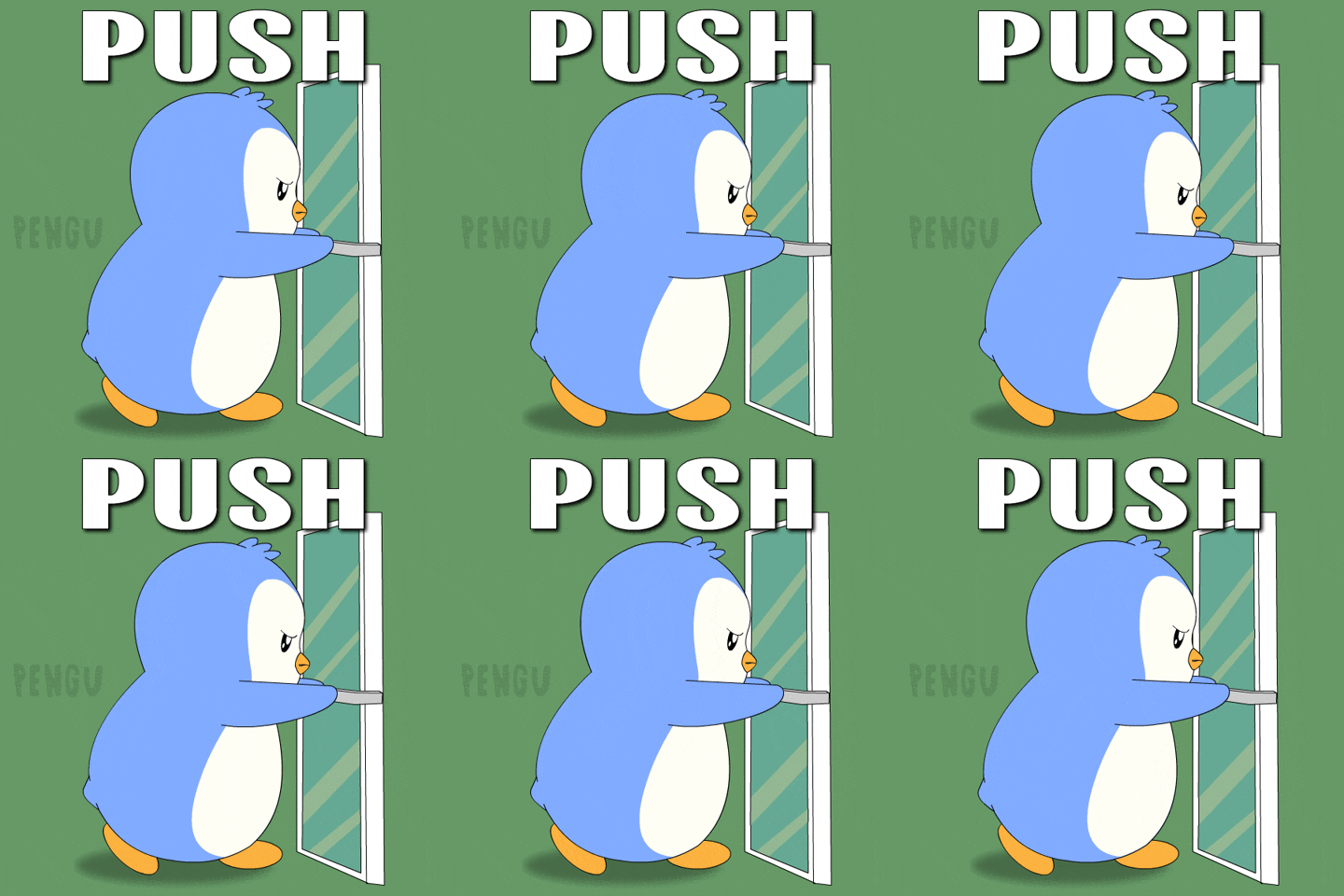
And that's a pattern worth remembering, because confidence doesn't prevent misreads. It amplifies them. The more certain you feel, the more spectacular the failure becomes. That principle shows up in funny little moments like this — but it also shows up in places where the consequences are far bigger than a bruised ego. First, though, science has something fascinating to say about why your brain keeps doing this to you.
Why Your Brain Betrays You Daily
Here's something cognitive scientists want you to know: your brain isn't glitching — it's taking shortcuts. Researchers call these moments "misapplied schemas." Your brain constantly pattern-matches against past experiences to navigate the world faster, and it's remarkably good at it. But occasionally, it applies the wrong template to the wrong moment. That pull door looked exactly like every pull door you've ever opened. The waiter's farewell matched a thousand goodbye scripts.
What's truly surprising is the scale. Researchers estimate you make hundreds of these micro-misreads every single day — you just only notice the embarrassing ones. So what happens when an entire group of people misreads the same situation simultaneously?
The Birthday Party That Wasn't Yours
A group walks into a restaurant and spots balloons, streamers, and a cake at a nearby table. They assume it's their friend's surprise setup and sit right down. One person grabs a party hat. Another starts pouring drinks. Someone actually begins singing "Happy Birthday" — and the real party guests just stare, frozen in polite confusion. This actually happens more often than you'd think, and the wildest part isn't the initial mistake.
It's what happens next. Instead of apologizing and retreating, people in these situations frequently double down — committing harder to the wrong reality rather than facing the awkwardness of admitting the error. That instinct to keep going when you should stop? It doesn't just ruin dinner parties. It quietly damages relationships people care about most.
Misreading Sarcasm Costs Real Friendships
Here's where misreading situations stops being funny. A University of Memphis study found that adults over 50 misread sarcasm in text messages at nearly double the rate of younger people. It's not about intelligence — it's about context. Sarcasm evolved differently in digital communication, where tone is invisible and punctuation carries emotional weight that didn't exist twenty years ago. Your adult daughter texts "wow thanks for the advice" and means the opposite. You take it at face value. She thinks you're ignoring her feelings. You think the conversation went fine.

These tiny misreads accumulate silently. Therapists report that misunderstood texts are now among the most common triggers for conflict between parents and adult children — real rifts over imaginary slights. But there's a remarkably simple technique that stops these arguments before they start.
One Simple Texting Trick Prevents Fights
Here's something you can try right now. Next time a text from your kid or friend feels cold, dismissive, or rude — don't respond yet. Instead, read it out loud in the most cheerful voice you can manage. Literally say it like you're announcing a birthday surprise. Therapists call this "assuming positive intent," and it works because most texts aren't written with the emotion you're reading into them. If the message sounds perfectly reasonable in a happy tone, it probably was neutral all along.
Think about the last text that stung a little. Would it have bothered you if you'd heard it spoken with a smile? That small mental shift has saved countless relationships from unnecessary damage. But misreading doesn't just happen on our phones — sometimes it ambushes us in the most high-pressure moments imaginable.
The Job Interview Handshake Gone Wrong
Here's something hiring managers won't tell you publicly: the handshake-fist bump collision happens in nearly every round of interviews. You extend your hand confidently, they go for the bump, and suddenly you're awkwardly gripping their knuckles like you're examining a piece of fruit. Or worse — you misread their professional handshake as warmth and go full hug. One recruiter described it as watching someone's soul leave their body in real time.
But here's the surprising part. Multiple hiring managers confess that candidates who laugh it off and recover gracefully actually become more memorable — in a good way. That moment of awkward recovery reveals genuine character that rehearsed answers never could. Remember the confidence thread from the push-door problem? Turns out confident people who stumble well outperform those who never stumble at all. And that principle applies in places far more critical than a job interview lobby.
Doctors Misread Patients More Than You Think
Remember that push door you confidently yanked in the wrong direction? Now imagine that same mental shortcut — but your doctor is making it with your health. A Johns Hopkins study found that diagnostic errors affect roughly 12 million Americans every single year. That's one in twenty adult patients receiving a wrong or delayed diagnosis. The primary cause isn't incompetence. It's anchoring — doctors forming a first impression within seconds and unconsciously filtering everything afterward to confirm it.
Twelve million people annually, misread by trained experts who genuinely believe they're reading the situation correctly. If the most educated professionals on earth fall for the same mental shortcuts that make us pull push doors, misreading situations isn't a personal failing. It's a human one. The good news? There's a proven way to make your doctor hit pause.
How to Make Your Doctor Listen Better
Here's something you can do before your next appointment that takes ten minutes and could change everything. Grab a piece of paper and write a one-page summary: your symptoms, when they started, what makes them better or worse, and what you've already tried. Then hand it to your doctor at the start of the visit. Research shows that receiving a physical document interrupts a physician's autopilot pattern-matching — it forces them to process your specific situation instead of defaulting to their fastest assumption.
Start with one powerful sentence: "I want to make sure we don't miss anything." That phrase signals you're a collaborative partner, not a passive patient. It changes the entire dynamic. You've just taken control of one of the highest-stakes misreads in daily life. Now let's lighten things up — because sometimes the funniest misreads happen between the two people who know each other best.
The Couple Who Planned Two Vacations
A married couple — together over twenty years — each secretly decided to surprise the other with a vacation. He booked a cozy mountain cabin. She booked a beachfront resort. Same dates. Neither said a word until two weeks before departure, when both proudly announced their surprise at the dinner table. The internet fell in love with this story because it's the perfect illustration of how long-term love creates comfortable assumptions. You know your partner so well that you stop checking what they're actually doing.
They eventually compromised — mountains first, then beach — and called it the best trip they'd ever taken. But the real lesson hit home for millions of married couples reading along: the longer you know someone, the bigger your blind spots grow. Think about your own closest relationship right now. What are you assuming without asking? That instinct to skip the conversation has a name, and professionals actually train people to overcome it.
Reading a Room Is a Trainable Skill
Here's something most people don't realize: FBI behavioral analysts aren't born with supernatural people-reading abilities. They train for thousands of hours in micro-expression recognition and contextual awareness — because reading a room is a skill, not a gift. Social intelligence researchers have confirmed this works at any age. Your brain's ability to accurately assess social situations actually improves with deliberate practice, just like any other muscle.

The technique professionals use is deceptively simple: scan before you speak. Before saying a single word, observe body positions, crossed arms, who's checking their phone, where the energy sits. That quick visual sweep gives you information most people completely miss. But scanning is only step one. What you do in the next three seconds matters even more.
The Three-Second Pause That Changes Everything
Here's the technique crisis counselors and hostage negotiators swear by, and you can start using it today. When someone says something that triggers an emotional response — frustration, defensiveness, hurt — count to three before you say a single word. One Mississippi. Two Mississippi. Three Mississippi. That's it. Neuroscience explains why this works: most social misreads happen within the first half-second of hearing something. Your brain grabs the fastest available interpretation, which is often wrong.
That three-second pause lets your prefrontal cortex catch up to your amygdala — your rational mind overriding your reactive one. Try it in your very next conversation. You'll be stunned by how different your response becomes when you give yourself those three beats. Sometimes an entire town needs more than three seconds — especially when the local newspaper prints the wrong date.
When a Whole Town Got the Date Wrong
In 1985, the small town of Estacada, Oregon experienced a beautiful accident. The local newspaper printed the wrong date for the annual summer festival — off by exactly one week. Hundreds of residents showed up on the wrong Saturday to find empty vendor stalls and no parade floats. Instead of going home embarrassed, they improvised. Neighbors dragged out grills, someone brought a radio, kids ran through sprinklers, and the whole town threw a spontaneous celebration in the park.
The unofficial gathering became so beloved that Estacada started hosting both weekends — the "Wrong Day Festival" and the real one. Sometimes an entire community misreading the situation creates something no one could have planned. Not every collective misread ends this sweetly, though — especially when you hit "reply all."
The Email That Went to the Wrong Person
Picture this: you're venting about your boss in an email to your best work friend. You hit send. Then your stomach drops — you sent it directly to your boss. A CareerBuilder survey found that one in four workers has sent an email to the wrong person, and the consequences weren't just embarrassment. People have been fired, demoted, and even sued over misdirected messages.
This is autopilot at its most dangerous. Your fingers move faster than your judgment, and one click reshapes your entire career. Have you ever caught yourself mid-send with your heart racing? Most people who've lived through this nightmare desperately wish they'd known about one particular button — that almost nobody realizes doesn't actually work.
The "Recall" Button Doesn't Actually Work
Here's what IT professionals won't sugarcoat: Outlook's "recall message" feature fails the vast majority of the time. It only works if the recipient uses Outlook on the same server, hasn't opened the email yet, and isn't on their phone. Worse, attempting a recall sends a second notification that essentially says "please pay extra attention to the email I just sent." You're literally spotlighting your own mistake. Every IT department has watched someone turn a minor embarrassment into a company-wide spectacle by frantically hitting that recall button.
The real fix professionals use? A send delay — a one-to-two-minute window where every outgoing email sits in your outbox before actually leaving. It's the digital version of the three-second pause, and it's saved countless careers. Setting it up takes less than thirty seconds, and you're about to learn exactly how.
Set a Send Delay on Every Email Now
Here's your thirty-second setup. In Gmail, click the gear icon, select "See all settings," find "Undo Send," and change the delay to 30 seconds — it's the maximum Gmail allows, but it's enough. In Outlook, go to File, then Rules, create a new rule that defers delivery by one or two minutes for all messages. That's it. Every single email you send now has a built-in safety net. You'll never even notice the delay — until the one time it saves you from disaster.
Think of it as the three-second pause from Chapter 13, permanently built into your digital life. No willpower required, no habit to remember. It just quietly protects you, every single day. Now, if only there were a similar delay for financial decisions — because when the stock market crashes, the misreads get expensive fast.
The Investor Who Misread the Market Crash
The 2008 financial crisis was a masterclass in misreading the moment. Millions of everyday investors watched their portfolios plummet and panic-sold at the absolute bottom, locking in losses averaging 40% that many never recovered. Others made the opposite mistake — doubling down on collapsing banks like Lehman Brothers with the same misplaced confidence as someone yanking a push door harder. The market itself recovered fully within five years. Investors who simply did nothing came out whole.

The cruelest part? Both reactions — blind panic and stubborn confidence — felt completely rational in the moment. Your brain screaming "act now" was the same autopilot that replies "you too" to a waiter, just with your retirement savings on the line. So what do the professionals actually do when markets collapse? Their answer might surprise you.
What Financial Advisors Do During Panics
Here's the insider secret: when markets crash, the best financial advisors barely think at all. They open a binder — sometimes literally a physical binder — containing an Investment Policy Statement written months or years earlier, during calm markets. Then they follow it mechanically, step by step. They rebalance according to predetermined percentages. They don't improvise. The entire strategy rests on one powerful principle: your panicked self is the worst decision-maker you'll ever meet. So you don't let that version of you decide anything.

Professionals deliberately outsource judgment to their past, rational selves. This isn't just a finance trick — it's a life principle. Therapists, emergency responders, and military planners all use the same approach: pre-decide before the pressure hits. What if you could apply that same strategy to your most stressful personal moments?
Write Your Future Self a Calm Letter
Here's your assignment: today, while you're calm, grab a piece of paper and write a letter to your future stressed-out self. Pick a situation you know will happen — a market downturn, a tense holiday dinner, a scary medical result. Write exactly what you want yourself to do when that moment arrives. Be specific: "Do not sell any investments. Call your advisor. Take three walks before making any changes."
Therapists actually prescribe this technique for patients managing anxiety and panic disorders. The letter becomes your personal binder — your rational voice, preserved in ink, waiting for the exact moment you need it most. But not every misread needs preventing. Some of life's best moments start with getting it completely wrong.
The Proposal She Thought Was a Joke
Imagine getting down on one knee, heart pounding, ring box open — and the love of your life laughs in your face. It happens more often than you'd think. There's a whole beloved genre of proposal videos where one partner completely misreads the moment. She walks away saying "stop kidding around." He nervously laughs and asks what's for dinner. One woman famously told her boyfriend to "get up, you're embarrassing yourself" before the reality hit her like a wave.
Then comes the moment it clicks — hands over mouth, tears streaming, pure unfiltered joy made sweeter because of the seconds of confusion that came before. The misread didn't ruin the moment. It became the moment. The story they'll tell their grandchildren isn't "he proposed." It's "I almost walked away."
Speaking of getting it gloriously wrong — nobody on earth misreads situations quite like children do.
Children Are the World's Worst Situation Readers
A four-year-old at a funeral once tugged her grandmother's sleeve and announced, loud enough for every pew to hear, "When do they wake up?" At a wedding, a six-year-old asked the bride why she was wearing "her nightgown." And every parent knows the horror of a child on a work Zoom call cheerfully narrating their bathroom activities to your entire department. Kids aren't being rude — their brains literally cannot read situations yet.
Neuroscientists confirm that the prefrontal cortex, responsible for social context reading, doesn't fully mature until roughly age twenty-five. That means even teenagers are still developing this skill. Misreading situations isn't a flaw — it's a stage of being human that, honestly, none of us ever completely graduate from. Of course, there's one species that makes children look like seasoned diplomats.
The Dog Who Misread Every Situation Perfectly
Your dog watches you sob on the couch and thinks, "This seems like a great time for my squeaky hamburger." She drops it in your lap, tail wagging, absolutely certain this will fix everything. And somehow — impossibly — it kind of does. Dogs misread every human situation with spectacular consistency. They bark ferociously at their own reflections. They celebrate in the vet's parking lot, not knowing what's coming. They greet you after a ten-minute grocery run like you've returned from war.
But here's what gets me: dogs default to joy. Their misread is always in the direction of love, connection, and enthusiasm. Maybe that's not misreading the situation at all. Maybe that's reading something deeper than the rest of us can see.
Unfortunately, not everyone who misreads your situation has such pure intentions.
The Scam That Fools Smart People Daily
Here's where misreading situations turns dangerous. Phishing scams work not because victims aren't smart — they work because scammers hijack the same autopilot responses we've been discussing this entire article. That "official-looking" email from your bank? It's designed to trigger instant action before your brain engages. The FBI reports Americans over 60 lost $3.4 billion to online scams in 2023 alone. Three point four billion. Scammers deliberately manufacture panic — your account is compromised, act now, click immediately — specifically to eliminate that three-second pause we talked about earlier.
Think about it: every technique that makes you misread a harmless situation also makes you vulnerable to someone exploiting that same instinct. The good news? There's one devastatingly simple question that stops nearly every scammer cold.
The One Question That Stops Every Scammer
Here's your new rule, and please share it with everyone you love: when any message demands immediate action, ask yourself one question. "What happens if I wait 24 hours?" That's it. That single question dismantles nearly every scam ever designed. Your bank won't close your account because you waited a day. The IRS won't arrest you overnight. Medicare won't cancel your coverage by morning. Every legitimate organization in the world will give you twenty-four hours.

Scammers cannot survive that pause. Their entire business model depends on you never asking that question. The moment you wait, their power evaporates completely. Teach this to your parents, your spouse, your kids, your neighbors. One question, universal protection. But what happens when an entire office skips the pause together?
The Retirement Party for the Wrong Employee
An entire office chipped in for catering, a custom cake, heartfelt speeches, and a genuine gold watch — all for an employee who had absolutely no plans to retire. Multiple verified versions of this story exist across different companies, which somehow makes it even better. The guest of honor sat through tearful tributes and a "thirty great years" slideshow before finally interrupting to explain they were just transferring to the accounting department downstairs. They'd still be in the same building. Using the same parking lot.
Remember the town that celebrated on the wrong day back in Chapter 14? Groups don't just misread situations — they build entire productions around the misread, each person's certainty reinforcing everyone else's. Nobody paused to verify because everyone else seemed so sure.
But here's something surprising: moments like these might actually be making you more likable than you realize.
Why Getting It Wrong Makes You Likable
Here's what social psychologists actually know: your mistakes are making people like you more. Researcher Elliot Aronson discovered what he called the "pratfall effect" — when someone who's clearly competent makes a visible blunder, observers consistently rate them as more likable and trustworthy than people who appear flawless. This held true across every age group tested. Think about the people you're closest to. Chances are, you bonded over shared embarrassments, not shared perfections.
Every cringe-worthy misread in this article — the wrong wave, the push door, the retirement party — isn't a flaw to hide. It's a social asset that signals authenticity and approachability. Your humanity is your warmth. Which raises an interesting challenge: what if you deliberately led with those stories?
Tell Your Most Embarrassing Story First
Here's your challenge: at your next dinner, coffee date, or family gathering, be the very first person to share a misread story. Don't wait for someone else to go first. Try this simple framework: "I once completely misread..." then describe the situation, what happened next, and how you laugh about it now. That's it — three beats. Research on vulnerability shows that whoever opens up first gives everyone else permission to be real. The conversation transforms instantly from polite small talk to genuine connection.
You've spent this entire article recognizing yourself in these stories. Now give someone else that same gift out loud. Pick your favorite misread memory, practice those three beats, and watch what happens when you own it first. Because those stories you've been quietly cringing about? They're about to become something far more meaningful.
Your Worst Misread Became Your Best Story
Think about your family's greatest hits — the stories that make everyone howl every Thanksgiving. They're never about promotions or perfect days. They're about the time Grandpa waved enthusiastically at a complete stranger for thirty seconds. The time Mom walked into the wrong house and sat down on a stranger's couch. The time you said "you too" when the flight attendant said "have a nice flight." These moments felt like tiny disasters when they happened.
But time performs this quiet alchemy, turning embarrassment into gold. Your worst misreads became the stories that make your grandchildren laugh until they cry. They're the threads that stitch your family together across decades. No one retells the time everything went perfectly. So what's the real takeaway from all twenty-three of these beautiful human blunders?
Go Ahead — Misread the Situation Today
So go ahead. Wave at the stranger who wasn't waving at you — just like we started this journey together. Push the pull door with full confidence. Tell the waiter "you too" and mean it. You now understand the science behind why your brain does this, the real stakes when it matters, and the tools to catch yourself when it counts. But here's what matters most: don't you dare stop showing up fully just because you might get it wrong.
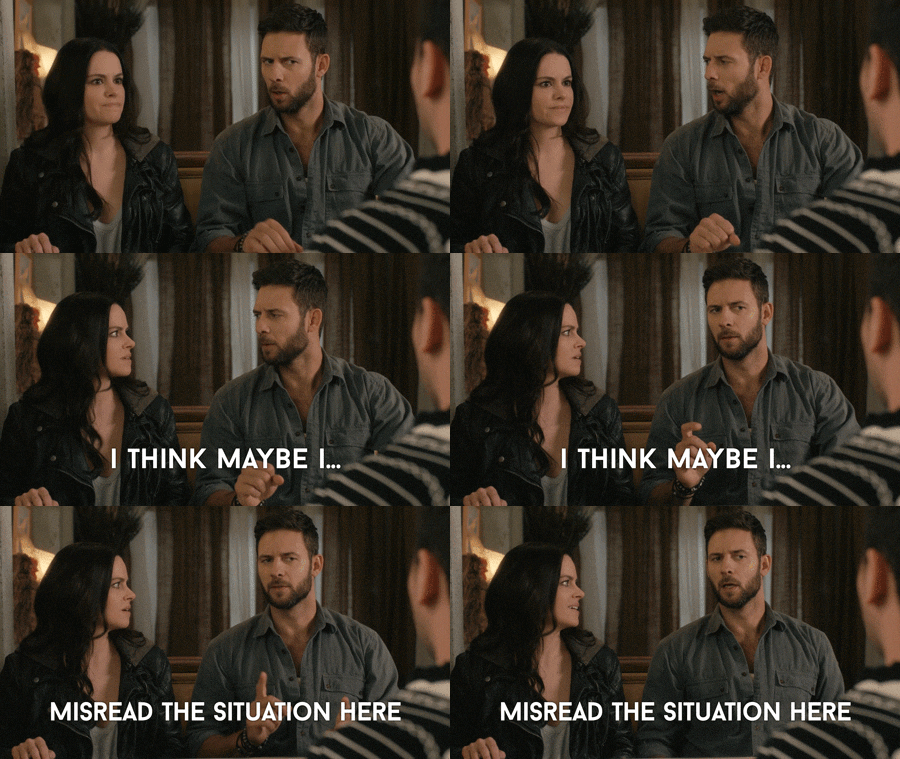
A perfectly read life is a small life. The people who misread situations are the people actually in them — living, connecting, trying. Your next beautiful blunder is waiting. Now drop your favorite misread story in the comments — we could all use the laugh.Disclaimer: This story is based on real events. However, some names, identifying details, timelines, and circumstances have been adjusted to protect the privacy of the individuals involved. The images in this article were created with AI and are illustrative only. They may include altered or fictionalized visual details for privacy and storytelling purposes